


How Will App Development Change in 2027? Data, AI and Security Are Raising the Bar for Architecture
When developing a web or mobile application, it is no longer just about what the product should do, how it should look, or which technologies it should run on.
It is becoming increasingly important to think about where the application will get its data from, which systems it will connect to, how permissions will work, and how easily new functionality can be added in the future. One of the biggest drivers of this change is AI.
In 2027, the difference may become even more visible between an application that works well today and a product whose architecture is ready to adapt to what comes next.
An application is no longer just what the user sees
Users see screens, forms, buttons, and the results of their actions. Behind a modern web or mobile application, however, there is often a much more complex ecosystem.
Backend services, databases, analytics, CRM, ERP, payment services, third-party APIs, cloud services, and increasingly, AI models.
That is why application architecture is becoming more important. A well-designed product should not be built only around the features it needs at launch. It should also be able to grow and connect to new services without every major change requiring a redesign of the entire system.

Data will become even more important for the future development of applications
AI is accelerating this shift, especially when it comes to data.
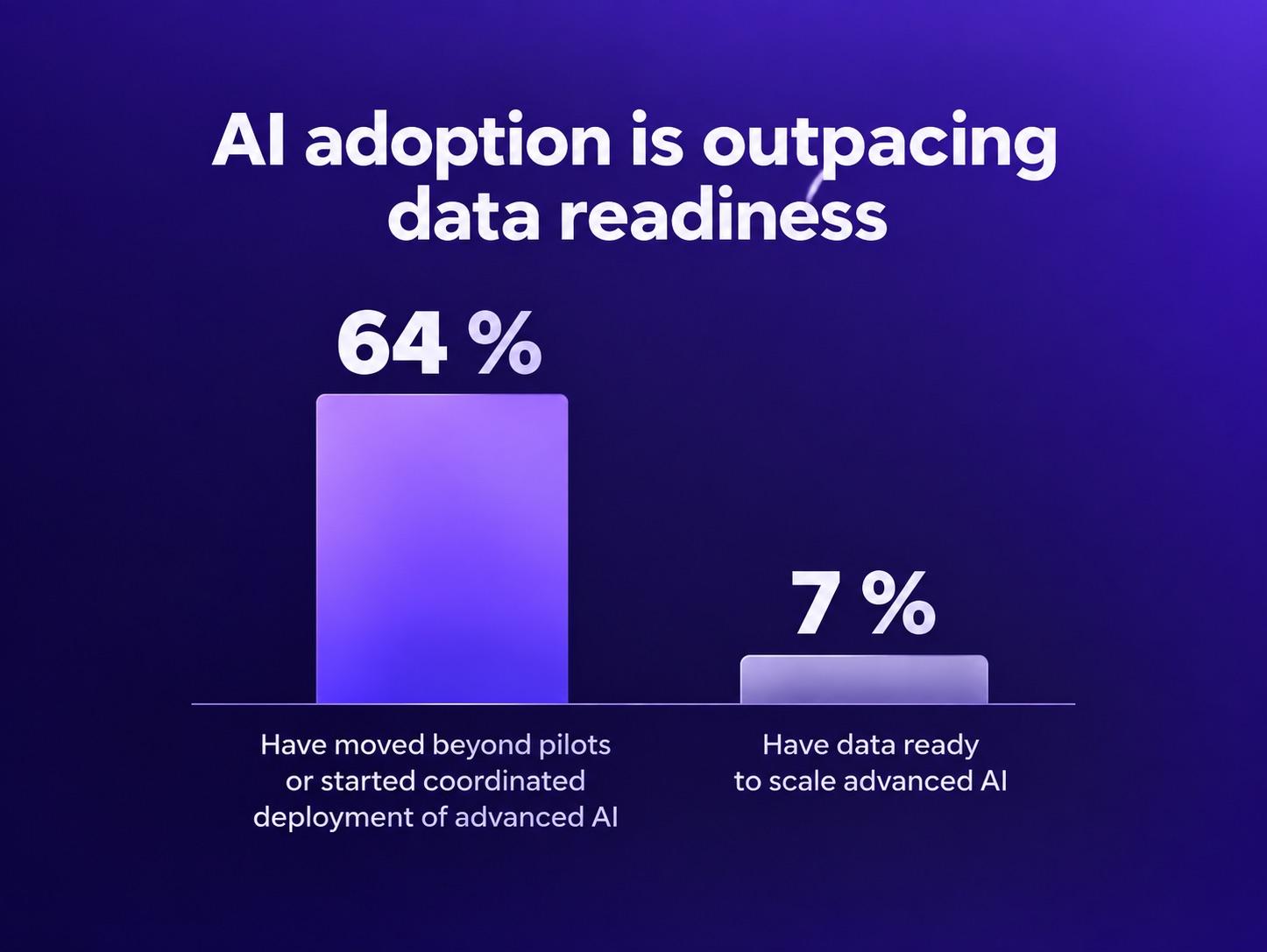
According to Accenture, 64% of surveyed companies have moved beyond the pilot stage or started coordinated deployment of advanced AI. However, only 7% have reached the level of data readiness needed to scale it. The research covered 2,000 companies across 15 countries and nine industries.
For application development, this is an important signal. If a product is expected to use intelligent search, recommendations, automated document processing, personalisation, or other AI capabilities in the future, it first needs high-quality and accessible data.
Simply connecting a new model later is not enough.
If data is fragmented across several systems, lacks a clear structure, or access rights are poorly defined, further development can quickly run into limitations created by the original architecture.
AI is gradually becoming a natural part of applications
AI features no longer have to mean a separate chatbot or a prominent button labelled “AI”.
Artificial intelligence can work in the background with documents, classify data, support search, personalise content, or prepare the next step in a process. For users, it is gradually becoming a natural part of how the product works.
At the same time, this changes the requirements for development.
An AI service may have a different response time from a standard API, its output may not always be identical, and the application also needs to handle situations where the model or an external service is unavailable.
Architecture therefore needs to address not only what AI can do, but also how it is integrated into the rest of the product and how the application behaves in different scenarios.
You can read more about how AI is becoming a less visible and more natural part of mobile applications in the article Invisible AI.
AI agents add another layer of automation
AI agents may bring an even bigger shift.
A typical AI feature usually generates an answer or an output. An agent can retrieve data from several systems, call APIs, perform a sequence of steps, and then carry out a specific action.
According to Deloitte, 74% of respondents expect their company to use AI agents at least to a moderate extent by 2027, while only 21% of organisations report having a mature governance model for managing them. The survey included 3,235 senior business and IT leaders across 24 countries and six industries.
From a development perspective, the difference is significant. Once AI can modify data, work with other systems, or trigger processes, applications need much more precise control over permissions and oversight.
Which data can an agent only read? What can it change? Which actions can it perform automatically, and which still need human approval?
You can learn more about AI agents and other changes companies may face in 2027 in the article AI in 2027: Agents, New Skills and Growing Pressure on Security.
New possibilities also increase the importance of security
The more systems are connected and the more data an application processes, the more important security becomes.
The World Economic Forum reports that 87% of respondents identified AI-related vulnerabilities as the fastest-growing cyber risk during 2025. At the same time, the share of organisations systematically assessing the security of AI tools increased from 37% to 64%.
For application development, this means security increasingly needs to be addressed at the architecture stage.
For application development, this means security increasingly needs to be addressed at the architecture stage.
It should be clear where data comes from, where it is stored, which services can access it, and what individual users or automated processes are allowed to do.
As AI agents become more common, auditability will also become more important. In some cases, it will no longer be enough to know that something changed. It will also be necessary to trace what made the change.
Preparing an application for 2027 means planning for further AI development
AI can bring new capabilities to web and mobile applications, from smarter search and personalisation to automation and AI agents.
Not all of these features need to be included in the first version of a product.
What matters is designing the foundations so the product can continue to evolve. A well-structured data model, clear APIs, separation of individual system components, thoughtful permissions, and monitoring all have value on their own.
If there is later a need to add AI-powered search, automation, or an agent, these decisions can determine whether it becomes a natural extension of the application or requires changes to its foundations.
So what will be different about app development in 2027?
A strong frontend, the right technology stack, and good UX are not going anywhere.
Alongside them, however, data, integrations, security, and the ability of the architecture to adapt to new AI capabilities will play an increasingly important role.
AI is likely to become a more natural part of web and mobile applications in the coming years. Good architecture can therefore determine whether new features can be added gradually and efficiently, or whether every major extension requires changes to the foundations of the entire product.
In 2027, the ability of an application to keep evolving may be just as important as the features it launches with today.
Tell us about your project
Is it feasible?How much will it cost you?
And when will it be done?
We will discuss everything with you.